Henri Matisse Prints: Colour, Line and Creative Freedom
Henri Matisse is celebrated for paintings filled with vivid colour and for the bold paper cut-outs of his later years. Printmaking was another important part of his artistic life. Across a career spanning several decades, he explored etching, lithography, woodcut and stencil printing, using each method to distil his subjects into expressive lines and shapes.
Matisse’s prints are often recognisable for their apparent simplicity. A portrait may be reduced to a few fluid contours; a still life might balance just a handful of forms. Yet this economy was carefully considered. Rather than adding detail for its own sake, Matisse sought the essential character of a face, figure or object.
A varied printmaking practice
Matisse began making prints around the turn of the twentieth century and returned to the medium throughout his career. He produced etchings and drypoints, in which a line is incised into a metal plate, as well as lithographs, where the image is drawn on a flat stone or prepared surface. He also made woodcuts, a technique that can give lines a strikingly direct, graphic quality.
Printmaking offered Matisse opportunities to experiment with line and repetition. The constraints of a particular technique could sharpen his compositions, while the possibility of producing multiple impressions allowed his images to reach a wider audience. His print work includes portraits, figure studies, landscapes and illustrations for books.
Jazz and the language of cut paper
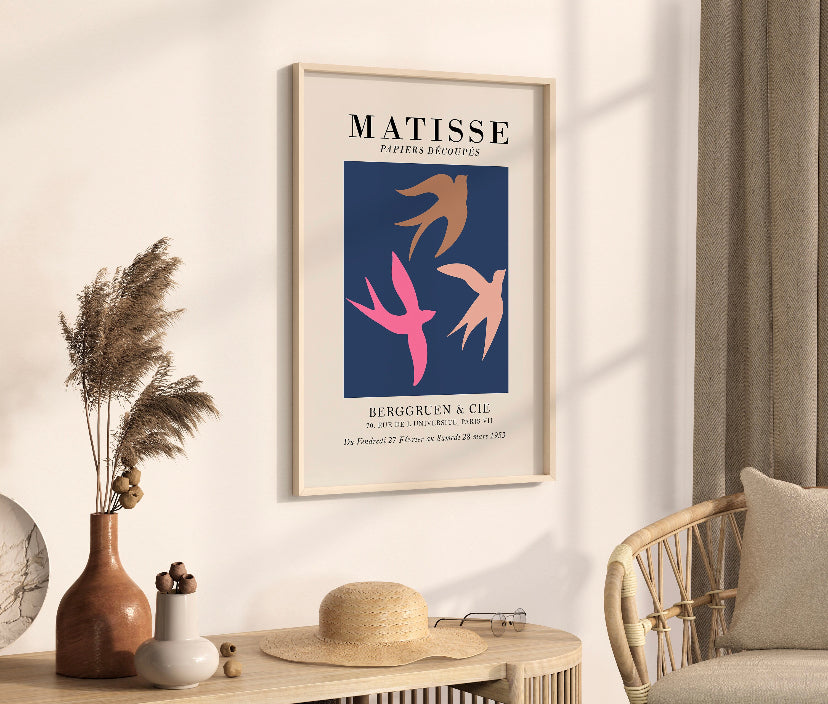
One of Matisse’s best-known print-related projects is Jazz, published in 1947. The book brings together colourful images made from paper cut-outs, alongside the artist’s handwritten text. Matisse arranged shapes cut from painted paper, creating compositions that feel spontaneous but are built on a precise sense of balance, rhythm and colour.
The images were reproduced using the pochoir process, a stencil-based method that allowed colour to be applied by hand. Jazz includes some of Matisse’s most recognisable compositions, including the blue figure studies often known as the “Blue Nudes”. The project shows how print production could help translate his cut-paper designs into a carefully controlled edition.
Portraits and expressive line
Portraiture is a recurring subject in Matisse’s graphic work. His drawn and printed portraits often use a spare, continuous-looking line to suggest a sitter’s features, expression and pose. The result can seem effortless, but the composition depends on what the artist chooses to leave out as much as on what he includes.
This directness connects Matisse’s prints with his wider artistic approach. Whether working in black and white or with colour, he aimed to create images that felt clear, harmonious and alive. A small number of lines could carry as much expressive force as a densely worked image.
Original prints and reproductions
The term “Matisse print” can refer to different kinds of works. An original print is an impression made from a matrix—such as a plate, stone or block—with the artist’s involvement in creating or approving the image. A reproduction, by contrast, is a later copy of an existing artwork, often produced through photographic or digital processes.
When considering a print, check its title, date, technique, publisher and edition information. A reputable gallery or seller should be able to explain whether the work is an original impression, a later authorised edition or a reproduction. Documentation and condition reports can also help clarify a print’s history. Signatures and edition numbers are useful details, but they should be considered alongside reliable provenance and expert advice.
A lasting influence
Henri Matisse’s prints reveal an artist continually testing how much an image can communicate with the fewest possible means. His command of line, shape and colour gives the works an immediate appeal, while their careful construction rewards closer attention. From the elegant economy of his portraits to the exuberant cut-paper compositions of Jazz, his graphic art remains an inviting introduction to one of modern art’s most influential figures.
Exploring Henri Matisse Prints: 7 Essential Tips for Art Enthusiasts
- Look for bold colours and simplified forms in Matisse’s prints.
- Notice how empty space shapes the composition.
- Compare his line drawings with his cut-paper designs.
- Check the print’s medium, such as lithograph or etching.
- Distinguish original prints from later reproductions.
- Ask for provenance and condition details before buying.
- Keep prints away from direct sunlight and damp.
Look for bold colours and simplified forms in Matisse’s prints.
When looking at Henri Matisse prints, notice how bold colours and simplified forms work together to create striking, balanced compositions. Rather than relying on intricate detail, Matisse often reduced a subject to its essential shapes and lines, allowing colour, pattern and empty space to carry the expression. This clear, confident approach gives his prints their distinctive energy and makes even simple forms feel lively.
Notice how empty space shapes the composition.
When looking at Henri Matisse prints, notice how the empty space shapes the composition. The areas around and between figures, objects and lines are not merely blank; they help guide the eye, create balance and give each form room to stand out. Matisse often used simplicity with great care, so the spaces he left untouched can be just as expressive as the marks he made.
Compare his line drawings with his cut-paper designs.
Compare Henri Matisse’s line drawings with his cut-paper designs to see how he explored the same subjects in different ways. His drawings often use a few fluid, economical lines to capture a figure or face, while his cut-outs express form through bold shapes, vivid colour and carefully balanced space. Looking at both side by side reveals how Matisse could distil an image to its essentials, whether working with a pen or painted paper.
Check the print’s medium, such as lithograph or etching.
When buying or researching Henri Matisse prints, check the medium—such as lithography, etching or woodcut. Each technique produces distinctive marks and textures, and knowing which was used can help you understand how the image was made and assess how it is described by a gallery or seller. If the listing is unclear, ask for details about the printing process and whether the work is an original print or a reproduction.
Distinguish original prints from later reproductions.
When buying Henri Matisse prints, check whether a work is an original print or a later reproduction. An original print is made from a plate, stone, block or stencil, often as part of a documented edition; a reproduction is a copy of an existing image, produced later by photographic or digital means. Review the technique, date, publisher and edition details, and ask for provenance or a condition report. A signature or edition number can be helpful, but should not be treated as proof of authenticity on its own.
Ask for provenance and condition details before buying.
Before buying a Henri Matisse print, ask the seller for clear provenance and condition details. Provenance can help establish the work’s history and whether it is an original print, an authorised edition or a reproduction. A condition report should note any fading, discolouration, creases, tears, repairs or marks, as these can affect both the print’s appearance and value.
Keep prints away from direct sunlight and damp.
To help preserve Henri Matisse prints, keep them away from direct sunlight, which can fade colours and damage paper over time. Avoid damp areas too, as moisture may cause staining, mould or warping. Display prints in a stable, dry environment and consider UV-filtering glazing to offer extra protection.