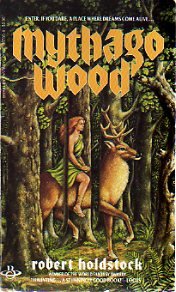
Mythago Wood: A Journey into the Forest of Myth
First published in 1984, Mythago Wood is a fantasy novel by British author Robert Holdstock. Set in the Herefordshire countryside, it begins with a seemingly simple idea: hidden within an ancient woodland is a world shaped by humanity’s oldest stories. The result is an eerie, deeply atmospheric tale about memory, myth and the pull of the unknown.
A forest with a life of its own
The story centres on Ryhope Wood, a patch of ancient forest on the Huxley family estate. From the outside, it appears modest in size. Within its boundaries, however, it expands into a vast and disorientating landscape. The deeper someone travels, the further they move from the familiar world—and the more time and ordinary rules seem to lose their meaning.
Ryhope is also the source of the novel’s “mythagos”: figures drawn from the shared well of human myth and memory. They may resemble characters from legend, but they are not simply imaginary beings. They take physical form in the wood, carrying the fears, desires and stories that have accumulated around their archetypes.
The Huxley family
After the Second World War, Steven Huxley returns to his family home and the wood that has long fascinated his father, George. His brother Christian is already deeply involved in exploring Ryhope, and his journeys lead him towards Guiwenneth, a compelling mythago associated with a powerful, ancient story.
As Steven tries to understand what has happened to Christian, the brothers’ different responses to the wood become central to the novel. Their exploration is not just a physical adventure: it brings old family tensions and personal obsessions into a place where myth can become more real than everyday life.
Myth, memory and the uncanny
Holdstock gives the novel a distinctive blend of fantasy and psychological unease. Ryhope Wood is not a conventional magical kingdom, with clear boundaries and rules. It is elusive and dangerous, changing as its visitors go further in. The forest’s power comes partly from the way it connects private experience with stories shared across generations.
This makes Mythago Wood as much a novel about the nature of myth as it is an adventure. It asks why certain stories endure, how they shape the way people see the world, and what happens when those stories take on a life of their own. Its richly imagined woodland also gives the book a strong sense of place, rooted in the landscapes and folklore of Britain.
A landmark of modern fantasy
Mythago Wood won the World Fantasy Award for Best Novel in 1985 and remains one of Holdstock’s best-known works. Its imaginative approach to folklore has influenced later fantasy that treats myth not as decoration, but as a force woven into the natural world and the human mind.
Holdstock returned to the world of Ryhope Wood in Lavondyss, a related novel that explores the forest from another perspective. But Mythago Wood stands on its own: a haunting invitation to step beneath the trees, where the oldest stories may be waiting in the dark.
Exploring Mythago Wood: A Haunting Blend of Folklore, Fantasy, and Mystery
- An original take on folklore.
- An atmospheric ancient woodland setting.
- Richly imagined mythological creatures.
- A compelling blend of fantasy and mystery.
- Thought-provoking themes of memory and myth.
- Strong sense of British place and landscape.
- An influential modern fantasy novel.
- A haunting story that lingers after reading.
Exploring the Challenges of ‘Mythago Wood’: Pacing, Obscurity, and Mythic Complexity
- The pacing can feel slow.
- The plot is deliberately obscure.
- Some characters feel underdeveloped.
- The prose can be dense.
- The shifting forest may confuse readers.
- Its mythic themes can feel abstract.
An original take on folklore.
One of Mythago Wood’s greatest strengths is its original take on folklore. Rather than retelling familiar legends, Robert Holdstock imagines a forest where mythic figures emerge from humanity’s shared memories and stories, taking on physical form. This inventive idea gives folklore a vivid, unsettling presence and makes the novel’s ancient woodland feel like a place where the past is constantly being created anew.
An atmospheric ancient woodland setting.
Ryhope Wood’s ancient, shadowy woodland setting gives Mythago Wood much of its haunting appeal. Its tangled trees, deepening darkness and sense of immense age create an atmosphere of mystery, making the forest feel less like a backdrop and more like a living presence. As the characters venture further beneath its canopy, the familiar countryside gives way to an uncanny world where myth and reality blur.
Richly imagined mythological creatures.
One of the great pleasures of Mythago Wood is its richly imagined mythological creatures. Robert Holdstock brings figures from ancient legends and the human imagination to vivid, unsettling life, making each encounter feel both wondrous and dangerous. These beings are more than familiar monsters or folklore characters: they embody deep-rooted stories, fears and desires, giving the forest a powerful sense of mystery and originality.
A compelling blend of fantasy and mystery.
Mythago Wood compellingly blends fantasy and mystery, drawing readers into an ancient forest where legends take physical form and reality becomes increasingly uncertain. As the characters venture deeper among its shifting paths and mythic inhabitants, each discovery raises new questions about the wood, its strange powers and the stories shaping their lives. This balance of wonder and suspense makes the novel both an imaginative fantasy and an absorbing mystery.
Thought-provoking themes of memory and myth.
One of the novel’s greatest strengths is the way it explores memory and myth as forces that shape both personal identity and shared human experience. In Mythago Wood, ancient stories are more than distant echoes: they emerge from the forest as living figures, reflecting the fears, desires and memories carried across generations. This imaginative premise invites readers to consider why certain myths endure and how the stories people inherit can influence the way they understand themselves and the world around them.
Strong sense of British place and landscape.
Mythago Wood has a strong sense of British place, grounding its strange events in the wooded countryside of Herefordshire. Robert Holdstock evokes the textures and atmosphere of the English landscape so vividly that Ryhope Wood feels both recognisable and uncanny: an ancient place rooted in local folklore, yet vast enough to contain whole worlds of myth. This close connection to landscape gives the novel a distinctive character and makes its fantasy feel deeply tied to Britain’s natural and cultural heritage.
An influential modern fantasy novel.
Robert Holdstock’s Mythago Wood is widely regarded as an influential modern fantasy novel for its original vision of a forest shaped by humanity’s oldest myths and memories. Rather than using folklore as mere decoration, Holdstock makes it the force that drives the story, creating a richly atmospheric world where ancient archetypes take physical form. Its imaginative approach to myth, place and the uncanny has helped shape the way later fantasy writers explore folklore and the stories that endure across generations.
A haunting story that lingers after reading.
One of the great strengths of Mythago Wood is its haunting atmosphere, which lingers long after the final page. Robert Holdstock blends ancient myth, family tensions and the unsettling mysteries of Ryhope Wood into a story that feels both strange and strangely familiar. Its images and questions stay with the reader, inviting reflection on the power of stories and the mysteries hidden within the natural world.
The pacing can feel slow.
The pacing in Mythago Wood can feel slow, particularly during its quieter stretches, when the story lingers on atmosphere, family tensions and the mysteries of Ryhope Wood rather than moving quickly from one event to the next. Readers expecting a fast-paced fantasy adventure may find this deliberate approach frustrating, though it also gives the novel time to build its eerie, dreamlike mood.
The plot is deliberately obscure.
One drawback of Mythago Wood is that its plot is deliberately obscure, leaving readers to piece together events and motivations without always receiving clear explanations. This ambiguity contributes to the novel’s dreamlike atmosphere, but it can also make the story feel confusing or slow, particularly for readers who prefer a more direct narrative.
Some characters feel underdeveloped.
One drawback of Mythago Wood is that some of its characters can feel underdeveloped. The novel’s rich mythology and mysterious atmosphere take centre stage, leaving less room for certain figures to gain depth or change in convincing ways. As a result, readers may find it harder to connect with some characters or understand their motivations, particularly when the story moves quickly into its more mythic and fantastical elements.
The prose can be dense.
One potential drawback of Mythago Wood is that its prose can feel dense, particularly when Holdstock describes the forest’s shifting landscape, mythic figures and layered symbolism. These passages create the novel’s distinctive, dreamlike atmosphere, but they can also slow the pace and make parts of the story harder to follow. Readers who prefer clear, brisk storytelling may find that the rich descriptions and ideas occasionally demand extra concentration.
The shifting forest may confuse readers.
The forest’s shifting nature is central to the novel’s mystery, but it can also make the story difficult to follow. Ryhope Wood changes as characters travel deeper into it, while time, distance and familiar rules become unreliable. Readers who prefer a clear map of events may find these transitions confusing, and the dreamlike atmosphere can sometimes make it hard to tell exactly what has happened or where the characters are.
Its mythic themes can feel abstract.
Although Mythago Wood is rich in folklore and symbolism, its mythic themes can sometimes feel abstract. The story is more concerned with archetypes, memory and the power of ancient tales than with clear explanations, which may make it difficult to grasp exactly what the wood represents or how its mysteries work. For readers who prefer a firmly grounded plot, this ambiguity can occasionally feel more puzzling than intriguing.