Art Nouveau Prints: Art for a Modern Age
With its flowing lines, graceful figures and intricate natural forms, Art Nouveau transformed the look of everyday life at the turn of the twentieth century. Prints played a central role in the movement, bringing its distinctive style beyond galleries and into homes, streets and public spaces.
What is Art Nouveau?
Art Nouveau was an international art and design movement that flourished from the late nineteenth century until the First World War. Its name means “new art” in French, and its artists aimed to create a fresh visual language suited to modern life. The style appeared in architecture, furniture, jewellery, illustration and graphic design, as well as in prints.
Although it took different forms in different countries, Art Nouveau is often recognised by its sinuous, asymmetrical lines and close attention to nature. Flowers, leaves, vines, birds and insects appear alongside stylised human figures. Rather than simply copying the natural world, artists adapted its shapes into elegant, decorative patterns.
The rise of the printed image
Advances in printing during the nineteenth century made it possible to reproduce images more widely and affordably. Colour lithography, in particular, allowed artists to create striking posters and other printed works with rich colour and fine detail. These images could reach a large audience, making the artist’s work part of everyday visual culture.
Art Nouveau posters advertised theatre performances, exhibitions, products and places. Their bold lettering and carefully composed illustrations were designed to catch the eye from a distance. At the same time, illustrated books, magazines and decorative prints brought the style into people’s homes.
Artists and signature styles
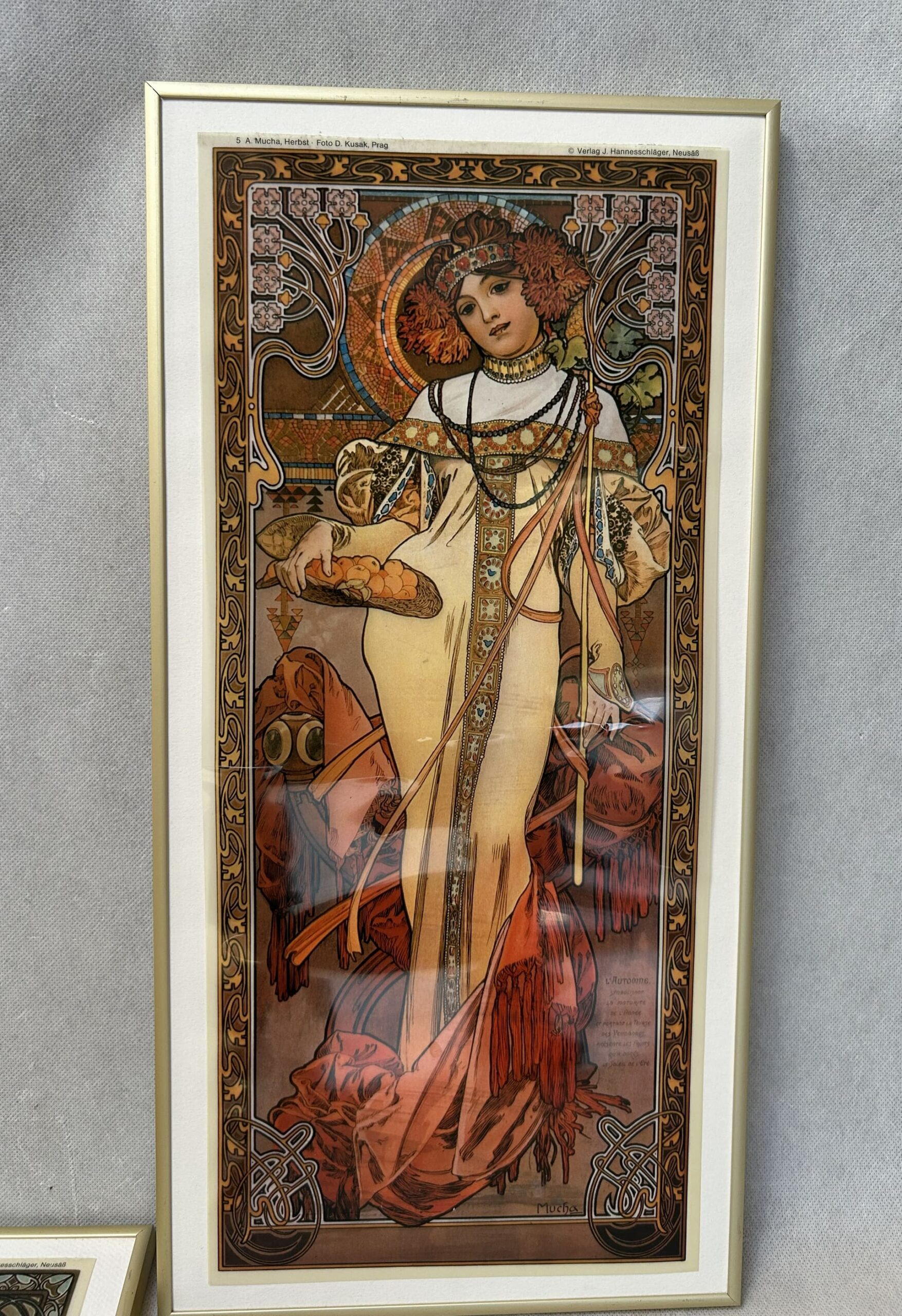
Several artists helped define the look of Art Nouveau printmaking. Alphonse Mucha became renowned for posters featuring elegant women, flowing hair, ornamental borders and floral motifs. His designs often combined lettering and image into a unified composition, and they remain among the best-known examples of the style.
In France, Henri de Toulouse-Lautrec used simplified shapes and strong outlines to capture the energy of Parisian nightlife. In England, Aubrey Beardsley developed a striking black-and-white style, using dramatic contrasts and intricate linework. Across Europe, artists drew on local traditions while sharing an interest in expressive design and the decorative possibilities of print.
How to recognise an Art Nouveau print
- Whiplash curves: Long, flowing lines often frame figures, lettering and botanical forms.
- Natural motifs: Plants and animals are frequently stylised into ornamental patterns.
- Integrated lettering: Typography is treated as part of the artwork rather than an addition.
- Stylised figures: Human forms may be elongated, elegant or arranged within decorative compositions.
- Strong outlines and colour: Many prints use clear contours and carefully limited palettes to make their designs legible and memorable.
Collecting and displaying Art Nouveau prints
Original Art Nouveau prints vary greatly in rarity, condition and value. Posters made for particular events or commercial campaigns may be especially sought after, while later reproductions are more widely available. When considering a purchase, check whether the work is an original print or a modern reproduction, and look for information about its artist, publisher, printing method and condition.
Paper is vulnerable to light, moisture and changes in temperature. To help preserve a print, display it away from direct sunlight and use archival-quality mounting materials. A professional framer can advise on suitable glazing and conservation methods, particularly for fragile or valuable works.
A lasting influence
Art Nouveau prints helped bring a new kind of design into public life. Their combination of image, lettering and decoration blurred the boundary between fine art and commercial art, while their natural forms offered an alternative to rigid, traditional styles. More than a century later, their visual energy continues to inspire illustrators, designers and collectors.
Understanding Art Nouveau Prints: Key Features, Renowned Artists, Authenticity, Valuation, and Preservation
- What are the defining features of Art Nouveau prints?
- Who are the most famous artists associated with Art Nouveau prints?
- How can you tell whether an Art Nouveau print is an original or a reproduction?
- How much are Art Nouveau prints worth?
- How should Art Nouveau prints be framed and cared for?
What are the defining features of Art Nouveau prints?
Art Nouveau prints are known for their flowing, sinuous lines, often described as “whiplash” curves, and their decorative, nature-inspired motifs, such as flowers, leaves, vines and insects. They commonly feature stylised figures, elegant compositions and carefully integrated lettering, with bold outlines and rich or limited colour palettes that make the design striking and easy to read. Together, these elements create a sense of movement and harmony between image and decoration.
Who are the most famous artists associated with Art Nouveau prints?
The most famous artists associated with Art Nouveau prints include Alphonse Mucha, celebrated for his elegant posters of women framed by flowing hair and floral motifs, and Henri de Toulouse-Lautrec, whose bold, lively designs captured Parisian nightlife. Aubrey Beardsley is known for intricate black-and-white illustrations, while artists such as Théophile Steinlen and Eugène Grasset also made a lasting contribution to the movement’s distinctive graphic style.
How can you tell whether an Art Nouveau print is an original or a reproduction?
To tell whether an Art Nouveau print is an original or a reproduction, look for evidence of its printing method, age and provenance. Original prints may show characteristic details such as lithographic texture, impressions from a printing plate, or period paper and signs of age, though these clues are not conclusive on their own. Check for a printer’s mark, publisher’s details, edition information or other documentation, and compare the work with reliable records of the artist’s known prints. Reproductions may have a modern, uniform surface or be printed on newer paper, but high-quality copies can be difficult to identify by sight. For a valuable or uncertain piece, seek an assessment from a reputable print specialist or conservator.
How much are Art Nouveau prints worth?
The value of an Art Nouveau print can range from a modest sum for a later reproduction to several thousand pounds for a rare, original work by a sought-after artist. Price depends on factors such as the artist, rarity, age, printing method, condition, provenance and current demand. Original posters by well-known artists may command higher prices, particularly if they retain their colour and have not been heavily restored. For a reliable estimate, compare recent auction results for similar prints and consult a reputable specialist, as a reproduction can look very similar to an original.
How should Art Nouveau prints be framed and cared for?
Art Nouveau prints should be framed using archival-quality, acid-free materials to help prevent discolouration and damage to the paper. Choose glazing that filters UV light, and avoid hanging the print in direct sunlight or in places with high humidity, such as bathrooms. If the print is valuable or delicate, consult a professional framer about conservation framing. Handle it with clean, dry hands, and keep it away from heat, moisture and sudden changes in temperature.