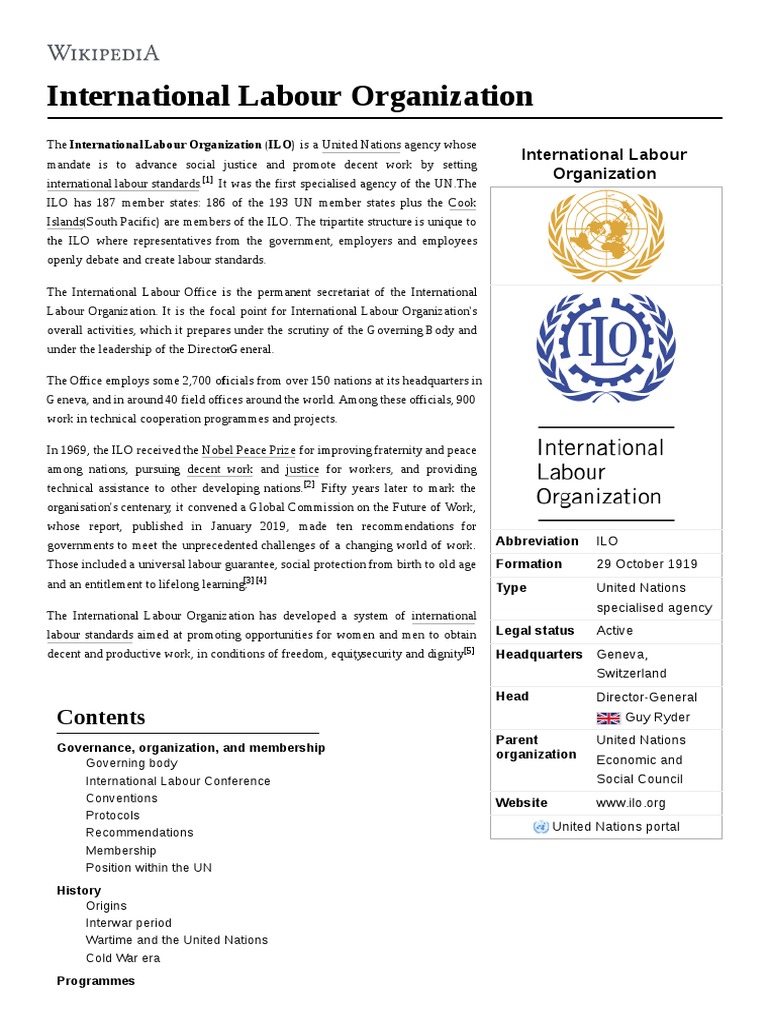
International Labour Organization Conventions: Setting Global Standards for Work
International Labour Organization (ILO) conventions are international agreements that set standards for workers’ rights and conditions of employment. They cover issues ranging from freedom of association and equal pay to workplace safety and the elimination of forced labour. By agreeing common principles, countries can work towards fairer and safer workplaces while adapting those principles to their own legal systems.
What is the ILO?
Founded in 1919, the ILO is a United Nations agency focused on social justice and decent work. It is distinctive for its tripartite structure: representatives of governments, employers and workers all take part in its work. These groups meet at the International Labour Conference, where international labour standards are discussed and adopted.
How conventions are adopted
A convention is adopted by the International Labour Conference following discussion among its delegates. Adoption establishes an international standard, but it does not automatically make that convention legally binding on every ILO member state.
Each member state is expected to submit newly adopted conventions to its competent national authority for consideration. A government may then ratify a convention, formally accepting the obligations it contains. Once ratified, the convention becomes binding on that country under international law, subject to its entry-into-force provisions. Governments are generally required to bring their laws and practices into line with the standards they have accepted.
Conventions are different from ILO recommendations. Recommendations provide guidance and are not open to ratification. They may accompany a convention, offering more detailed advice on how its principles could be put into practice.
Key areas covered
ILO conventions address a wide range of employment and workplace issues, including:
- freedom of association and collective bargaining;
- the abolition of forced labour;
- the elimination of child labour;
- equal remuneration and non-discrimination;
- minimum ages for employment; and
- occupational safety and health.
The ILO identifies ten conventions as fundamental because they relate to the principles and rights at work recognised in its Declaration on Fundamental Principles and Rights at Work. These include conventions on freedom of association, forced labour, child labour and discrimination, as well as two on occupational safety and health: the Occupational Safety and Health Convention, 1981 (No. 155), and the Promotional Framework for Occupational Safety and Health Convention, 2006 (No. 187).
Monitoring and implementation
Ratification is an important step, but effective implementation matters just as much. The ILO has supervisory procedures through which governments report on how they are applying ratified conventions. Workers’ and employers’ organisations also have a role in these processes, helping to highlight concerns and assess progress.
Supervision can draw attention to gaps between a country’s commitments and its laws or workplace practices. The ILO can provide guidance and technical assistance to help governments address these issues. The impact of a convention ultimately depends on how its standards are reflected in national law and upheld in practice.
Why the conventions matter
ILO conventions offer countries a shared framework for improving working life. They help define internationally recognised protections, support dialogue between governments, employers and workers, and provide a basis for assessing progress. Although countries differ in their economies and legal systems, these standards express a common goal: work should be carried out with dignity, fairness and respect for fundamental rights.
8 Tips for Understanding and Applying International Labour Organization Conventions
- Check whether your country has ratified the relevant ILO Convention.
- Read the Convention alongside national labour laws.
- Pay particular attention to the fundamental principles and rights at work.
- Remember that ratification creates obligations for governments.
- Look for guidance from workers’ and employers’ organisations.
- Check how the Convention is implemented and enforced nationally.
- Review government reports submitted to the ILO for progress updates.
- Use recognised complaint or supervision procedures to raise concerns.
Check whether your country has ratified the relevant ILO Convention.
Before relying on an International Labour Organization (ILO) Convention, check whether your country has ratified it. Ratification means the country has formally accepted the Convention’s obligations, although the protections may also depend on how they are reflected in national law and applied in practice. You can check ratification status using the ILO’s official NORMLEX database.
Read the Convention alongside national labour laws.
Read the relevant International Labour Organization convention alongside your country’s national labour laws to understand how its standards are put into practice. Comparing the two can clarify which rights and duties apply, how national rules interpret the convention, and where gaps or differences may exist.
Pay particular attention to the fundamental principles and rights at work.
Pay particular attention to the ILO’s fundamental principles and rights at work: freedom of association and the effective recognition of the right to collective bargaining; the elimination of forced labour and child labour; the elimination of discrimination in employment and occupation; and a safe and healthy working environment. These principles provide a useful starting point for understanding the purpose of ILO conventions and the protections they seek to promote worldwide.
Remember that ratification creates obligations for governments.
Remember that ratifying an International Labour Organization convention creates obligations for a government under international law. It must take steps to apply the convention’s standards in national law and practice, and report on how it is meeting those commitments.
Look for guidance from workers’ and employers’ organisations.
Workers’ and employers’ organisations can offer valuable guidance on International Labour Organization conventions, including how standards affect different sectors and how they can be put into practice. Their experience can help clarify workplace concerns, identify practical challenges and inform discussions about implementation. Consult representative organisations, such as trade unions and employer associations, alongside official ILO resources.
Check how the Convention is implemented and enforced nationally.
Before relying on an International Labour Organization convention, check how your country has implemented and enforces it. Find out whether the country has ratified the convention, what national laws or regulations give effect to its requirements, and which authorities are responsible for monitoring compliance. You may also want to look for inspection procedures, complaint mechanisms and recent reports on enforcement, as ratification alone does not guarantee that the convention’s standards are upheld in practice.
Review government reports submitted to the ILO for progress updates.
Reviewing government reports submitted to the International Labour Organization (ILO) is a useful way to track progress on labour rights and working conditions. These reports explain how a country is putting ratified ILO conventions into practice, including any steps taken, challenges encountered and areas where further action may be needed. Comparing reports over time can reveal progress and ongoing gaps, while comments from workers’ and employers’ organisations can provide additional perspectives.
Use recognised complaint or supervision procedures to raise concerns.
If you believe an International Labour Organization convention is not being respected, use recognised complaint or supervision procedures to raise your concerns. Depending on the issue and your country, this may involve contacting a trade union or employers’ organisation, reporting the matter to the relevant national authority, or submitting information through an ILO supervisory process. Check the applicable requirements and seek advice from a qualified organisation, as procedures and eligibility vary.