1970s Sci-Fi Art: Visions of the Future
Science fiction art of the 1970s imagined futures that were strange, beautiful and sometimes unsettling. Across book covers, magazines, comics and cinema, artists pictured distant planets, colossal spacecraft and unfamiliar forms of life. Their work reflected a decade fascinated by space exploration, new technology and the possibilities—and dangers—of human progress.
A decade of bold visions
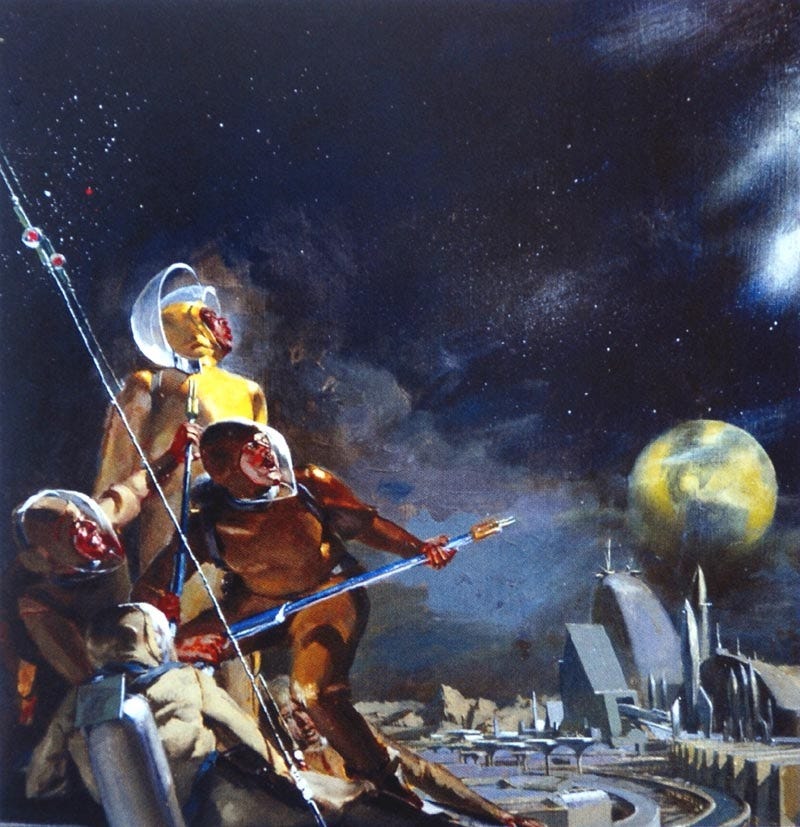
The Apollo Moon landings had made space travel feel newly real, while science fiction offered artists room to push beyond the limits of contemporary engineering. Their images ranged from detailed spacecraft and convincing planetary landscapes to dreamlike scenes shaped by psychedelic art. Airbrushed colour, dramatic lighting and intricate mechanical forms gave many illustrations a distinctive sense of scale and wonder.
Book covers played a major part in bringing this art to a wide audience. A striking image could transform an unfamiliar novel into an invitation to explore another world. Artists often had to convey a story’s atmosphere in a single scene, creating visual shorthand for alien civilisations, technological change and humanity’s future.
Artists and influential styles
Several artists helped define the look of the period. British artist Chris Foss became known for vividly coloured, heavily detailed spacecraft, often shown against vast, dark skies. French artist Jean Giraud, better known as Moebius, created imaginative landscapes and fluid, intricately drawn worlds that influenced comics and film design. Ralph McQuarrie’s concept art for Star Wars helped establish the visual language of one of the decade’s most influential science-fiction films.
Other artists explored sleek, futuristic design. Syd Mead’s work combined industrial detail with elegant forms, imagining technology as part of everyday life. Across the decade, styles varied widely: some artists favoured gritty, weathered machinery, while others pictured polished spacecraft, luminous cities and graceful alien environments.
From the printed page to the cinema
The 1970s brought science-fiction art to an even larger audience through cinema. Films such as 2001: A Space Odyssey, released in 1968 but hugely influential throughout the decade, set a high standard for carefully considered futuristic design. Later films, including Star Wars (1977) and Alien (1979), offered contrasting visions: one filled with adventurous space fantasy, the other with industrial grit and cosmic horror.
Concept artists, illustrators and designers helped turn scripts into tangible worlds. Their sketches and paintings shaped everything from spacecraft interiors to alien landscapes, connecting the imaginative freedom of illustration with the practical demands of film-making.
A lasting influence
1970s sci-fi art remains popular because it balances optimism with uncertainty. Its imagined futures could be wondrous, but they were rarely simple. Beneath the spectacle, many images asked questions about technology, environmental change, power and humanity’s place in the universe.
That visual legacy is still easy to spot in contemporary games, films, graphic novels and digital illustration. The decade’s artists did more than picture the future: they created worlds that continue to inspire audiences to imagine what might lie beyond the stars.
7 Tips for Creating 1970s-Inspired Sci-Fi Art
- Use bold, retro-futuristic colours.
- Paint dramatic cosmic landscapes.
- Add sleek spaceships and strange worlds.
- Try airbrushed gradients for a vintage feel.
- Mix imaginative technology with everyday objects.
- Use strong lighting to create mystery.
- Study 1970s sci-fi book covers for inspiration.
Use bold, retro-futuristic colours.
Use bold, retro-futuristic colours to give your sci-fi artwork the unmistakable spirit of the 1970s. Try pairing electric blues, vivid oranges and acid greens with deep blacks or inky purples to make planets, spacecraft and glowing cityscapes stand out. Strong colour contrasts can create a sense of cosmic wonder, while soft gradients and airbrushed effects add a nostalgic, otherworldly feel.
Paint dramatic cosmic landscapes.
In 1970s sci-fi art, dramatic cosmic landscapes can make distant worlds feel vast, mysterious and full of possibility. Use bold contrasts between deep space and glowing planets, then add swirling nebulae, jagged horizons or tiny spacecraft to create scale and movement. Rich, atmospheric colours—such as electric blues, fiery oranges and deep purples—help give the scene a striking retro-futuristic feel.
Add sleek spaceships and strange worlds.
Add sleek spaceships and strange worlds to capture the adventurous spirit of 1970s sci-fi art. Give your spacecraft bold shapes, streamlined details and a sense of movement, then set them against imaginative planets, alien landscapes or distant galaxies. Vivid colours and dramatic contrasts can help make the scene feel both futuristic and full of wonder.
Try airbrushed gradients for a vintage feel.
For a vintage 1970s sci-fi art feel, try using airbrushed gradients to create soft transitions between colours. Blend glowing oranges, pinks and purples across a distant planet or fade deep blues into black to suggest the vastness of space. Keep the edges hazy and the highlights luminous, and your artwork will capture the dreamy, otherworldly atmosphere of classic science-fiction covers.
Mix imaginative technology with everyday objects.
Mix imaginative technology with everyday objects to make your 1970s-inspired sci-fi art feel both fantastical and familiar. A futuristic communicator might resemble a telephone, while a spacecraft control panel could borrow details from radios, calculators or kitchen appliances. These recognisable touches help viewers connect with your imagined world, while unexpected shapes, glowing controls and inventive materials suggest how ordinary things might evolve in the future.
Use strong lighting to create mystery.
Use strong lighting to create mystery in your 1970s sci-fi art. A bright beam cutting through darkness can draw the viewer’s eye to a spacecraft, alien figure or distant landscape, while leaving key details hidden. Try dramatic contrasts between light and shadow, coloured glows from futuristic technology, or a hazy backlight to suggest something just beyond view. This approach adds atmosphere and suspense, inviting the audience to imagine what lies in the darkness.
Study 1970s sci-fi book covers for inspiration.
Study 1970s sci-fi book covers for inspiration: their bold colours, dramatic compositions and imaginative visions of distant worlds can offer plenty of ideas for your own artwork. Look closely at how artists used light, scale and unusual shapes to suggest mystery and adventure, then adapt those techniques to create a distinctive futuristic scene of your own.