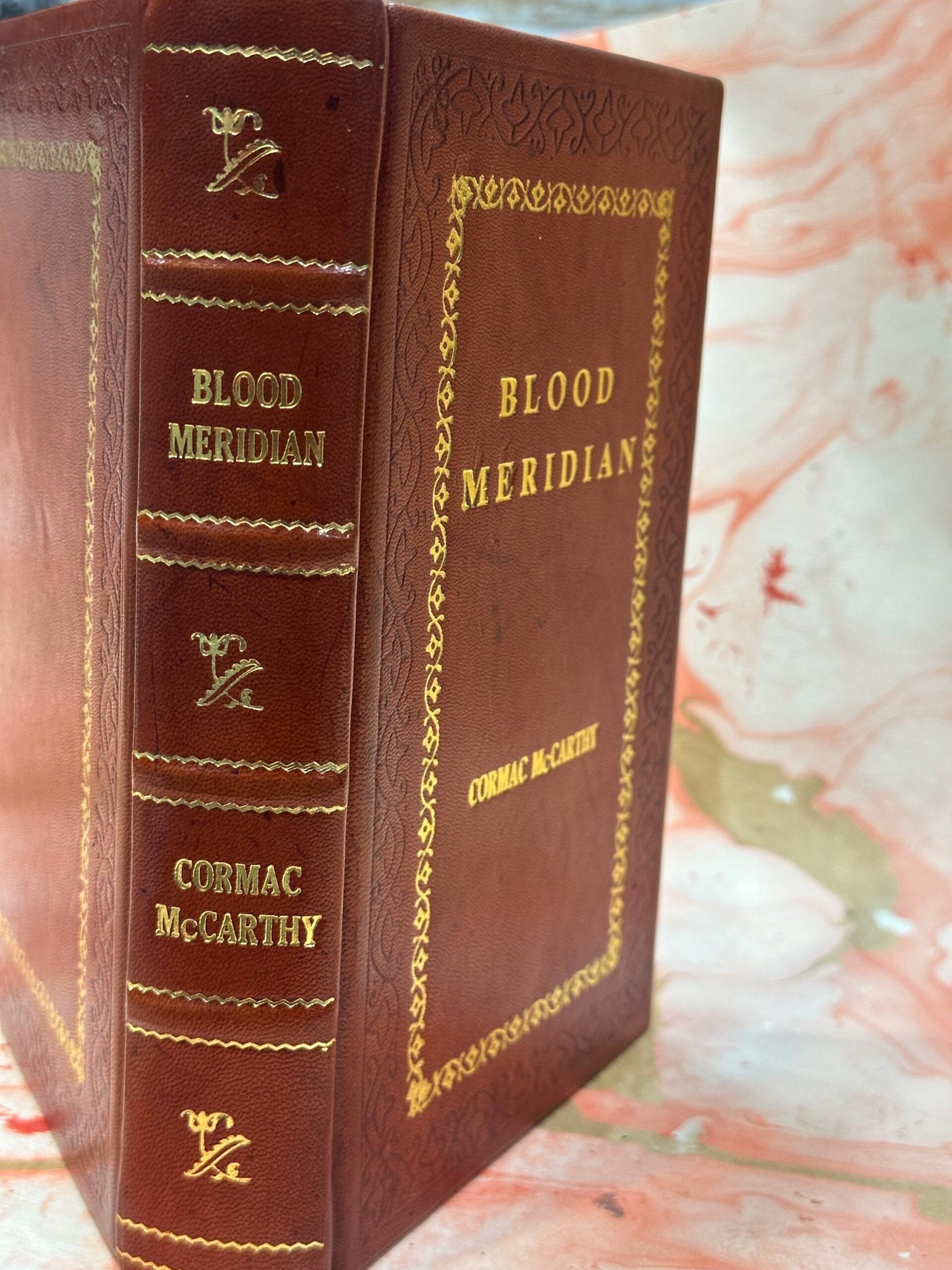
Blood Meridian by Cormac McCarthy: violence on the frontier
First published in 1985, Cormac McCarthy’s Blood Meridian, or The Evening Redness in the West is a stark, unsettling novel set in the American borderlands of the mid-nineteenth century. It follows a teenage wanderer known only as the Kid, who joins a band of scalp hunters led by the historical John Joel Glanton. Their journey through Mexico and the south-western United States becomes a vision of a world governed by brutality, where violence seems less an exception than a force woven into human history.
A journey through a violent landscape
The novel begins with the Kid’s childhood in Tennessee before carrying him west into a landscape of deserts, mountains and border towns. There, he encounters the Glanton gang: a ragged company hired to kill Indigenous people for bounty money. Their expedition is shaped by greed, colonial expansion and the pursuit of power. McCarthy draws on historical people and events, but Blood Meridian is not a straightforward account of the past. It transforms its material into something part historical novel, part nightmare.
At the centre of the gang is Judge Holden, one of McCarthy’s most memorable and disturbing creations. Enormous, hairless and seemingly inexhaustible, the Judge is at once a scholar, storyteller and advocate of war. He observes and categorises the world, yet his knowledge brings no compassion. Instead, it appears to serve his belief that domination is the ultimate law. His presence gives the novel a strange, almost mythic dimension, as if the gang’s violence were being watched and interpreted by a figure who sees conflict as humanity’s deepest purpose.
McCarthy’s style
McCarthy’s prose is a major part of the book’s force. He combines long, rhythmic sentences with vivid descriptions of the natural world and sudden eruptions of violence. Dialogue is often spare, while the narration can feel biblical in its scale and cadence. The result is demanding but immersive: the landscape is rendered with extraordinary intensity, and the reader is given little shelter from the events unfolding within it.
The novel is also notable for its use of punctuation. McCarthy often omits conventional quotation marks, allowing speech to flow into the surrounding narrative. This contributes to the book’s unsettled atmosphere, though it can make the text challenging at first. Its language is richly patterned, but it does not make the brutality beautiful or easy to accept. The contrast between lyrical description and horrifying action is part of the novel’s moral unease.
Violence, history and morality
Blood Meridian asks what it means to describe a nation’s founding as a story of progress. Its borderlands are not an empty wilderness waiting to be claimed; they are places shaped by Indigenous lives, competing powers and the consequences of conquest. The novel’s violence implicates the structures of empire and commerce as well as individual cruelty. The gang’s actions are horrific, but they belong to a wider history in which human lives are made expendable in the pursuit of territory and wealth.
The Kid is difficult to read as a conventional hero. He is capable of acts that suggest mercy, yet he remains part of the gang and rarely becomes a simple moral counterweight to it. This ambiguity prevents the story from offering easy reassurance. The book’s questions—whether violence is natural, whether people can resist it, and whether history records anything beyond the struggle for power—remain open to interpretation.
A challenging classic
Graphic, philosophically ambitious and formally distinctive, Blood Meridian is not an easy read. Its relentless violence may repel some readers, and its sparse character psychology can feel as harsh as its setting. Yet its combination of historical detail, poetic language and unsettling ideas has made it one of McCarthy’s most discussed novels.
For readers willing to confront its darkness, Blood Meridian offers more than a frontier adventure. It is a searching meditation on violence and the stories societies tell about it—an unforgettable work in which the beauty of the prose and the horror of the world remain in uneasy balance.
9 Tips for Reading Blood Meridian by Cormac McCarthy
- Expect a bleak, unconventional Western rather than a standard adventure.
- Read slowly
- Notice how the vast landscapes shape the novel’s mood.
- Track the Kid’s choices, even when his motives remain unclear.
- Pay attention to Judge Holden’s arguments and unsettling presence.
- Look for biblical language and echoes of older myths.
- Treat the violence as part of the novel’s moral inquiry, not mere spectacle.
- A map or brief history of the US–Mexico borderlands can help.
- Discuss the ending’s ambiguity rather than expecting firm answers.
Expect a bleak, unconventional Western rather than a standard adventure.
Expect a bleak, unconventional Western rather than a standard adventure. In Blood Meridian, Cormac McCarthy turns the frontier into a harsh, violent world, following a band of scalp hunters across the American borderlands. Its spare, poetic prose and unsettling reflections on human nature make for a challenging read, with little of the heroism or straightforward excitement associated with traditional Westerns.
Read slowly
Read Blood Meridian slowly. Cormac McCarthy’s dense, rhythmic prose and vivid descriptions reward careful attention, while the novel’s brutal episodes can be emotionally demanding. Take time to absorb the language, consider what each scene suggests, and pause when you need to—there’s no need to rush through this difficult, haunting book.
Notice how the vast landscapes shape the novel’s mood.
Pay attention to how McCarthy’s vast landscapes shape the mood of Blood Meridian. The deserts, mountains and open plains are more than a backdrop: their immense scale can make the characters seem small and exposed, while their harsh beauty deepens the novel’s sense of isolation and menace. Notice how the changing terrain influences the pace and atmosphere of the story, making the landscape feel almost as powerful—and indifferent—as the violence unfolding within it.
Track the Kid’s choices, even when his motives remain unclear.
Pay close attention to the Kid’s choices, even when McCarthy leaves his motives uncertain. Notice when he follows the gang, when he hesitates, and when he acts with unexpected restraint: these moments offer clues to his character without turning him into a straightforward hero. By weighing his actions against the Judge’s ideas about violence and power, you can trace the novel’s moral tensions while leaving room for ambiguity.
Pay attention to Judge Holden’s arguments and unsettling presence.
Pay close attention to Judge Holden’s arguments and unsettling presence. His erudition, confidence and fascination with violence make him far more than a conventional villain: he seems to offer a chilling philosophy of power and war. Consider how his speeches shape the novel’s ideas, and whether his imposing presence reveals the truth about the world he describes—or serves to make its brutality seem inevitable.
Look for biblical language and echoes of older myths.
As you read Blood Meridian, look for its biblical language and echoes of older myths. McCarthy’s elevated, rhythmic prose can make the events feel less like a conventional Western and more like an ancient, ritualised tale of violence and fate. Notice how the desert landscapes, the gang’s journey and Judge Holden’s pronouncements give the story a legendary scale, while also inviting questions about the beliefs and histories that shape its world.
Treat the violence as part of the novel’s moral inquiry, not mere spectacle.
When reading Blood Meridian, try to see its violence not as spectacle for its own sake, but as part of the novel’s moral inquiry. McCarthy’s brutal scenes challenge readers to consider how cruelty becomes normalised, how power is maintained, and whether violence is an individual choice or a force embedded in history and society. This approach can make the book’s disturbing moments more meaningful, while still recognising their unsettling impact.
A map or brief history of the US–Mexico borderlands can help.
A map or brief history of the US–Mexico borderlands can make Blood Meridian easier to follow, as the novel moves through regions shaped by shifting borders, conflict and competing claims to land. Familiarising yourself with the area’s geography and historical context can clarify the gang’s journey and deepen your understanding of the forces behind the story, without taking away from McCarthy’s stark, unsettling portrayal.
Discuss the ending’s ambiguity rather than expecting firm answers.
The ending of Blood Meridian is deliberately ambiguous, resisting a neat explanation of what happens to the Kid and what Judge Holden represents. Rather than looking for a definitive answer, consider how the final scenes echo the novel’s recurring ideas about violence, fate and the persistence of evil. McCarthy leaves crucial details unresolved, inviting readers to weigh the possibilities and decide what the ending means within the book’s bleak, unsettling vision of human nature.